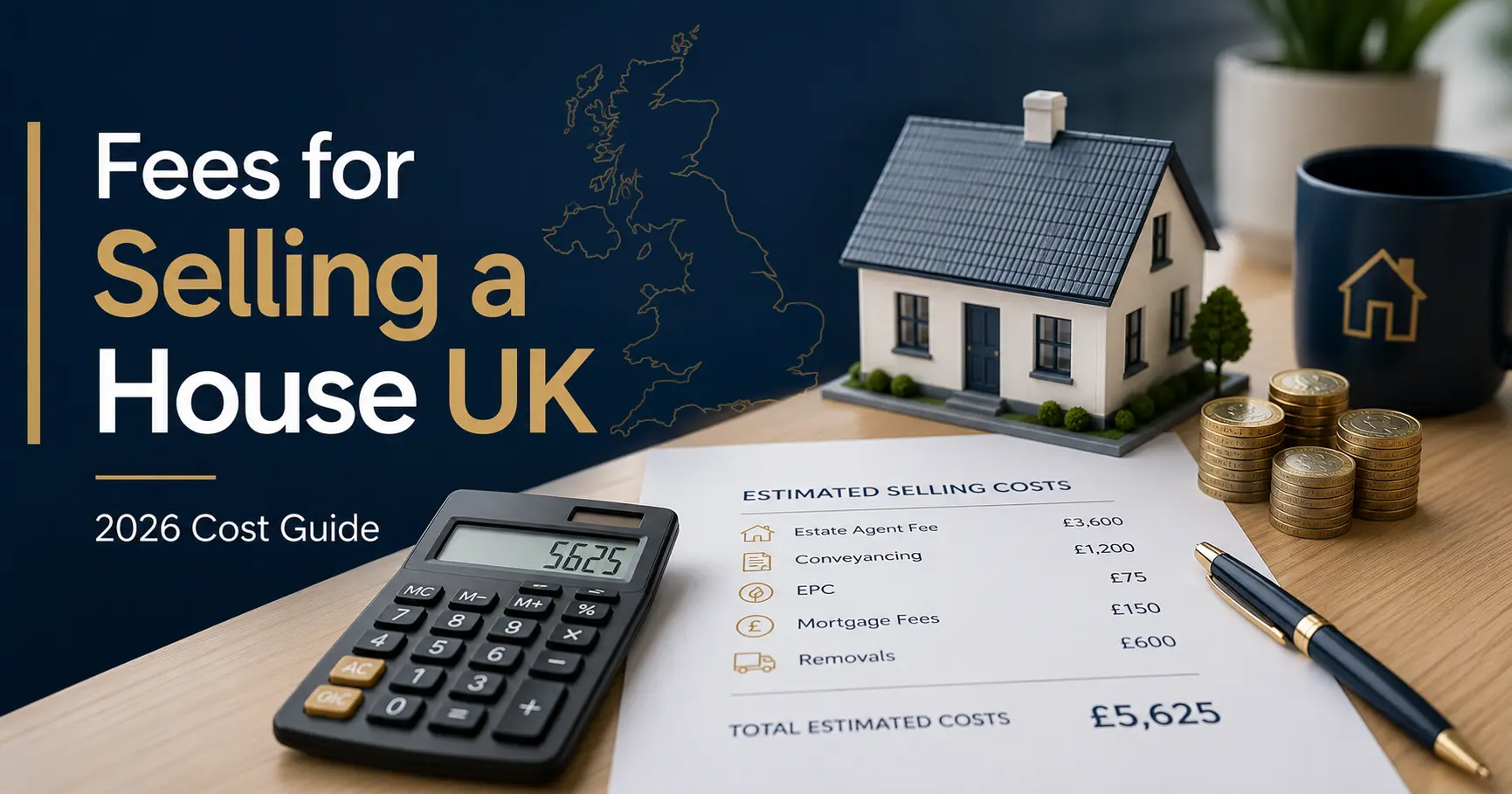
Fees for selling a house in the UK usually include estate agent commission, conveyancing, an Energy Performance Certificate and removal costs. Depending on the property and your mortgage, you may also face early repayment charges, leasehold administration fees, repair costs or Capital Gains Tax.
For a property selling for approximately £300,000, an illustrative budget for the principal selling costs is around £6,350. That example uses the 2026 average estate agent fee reported by MoneyHelper and mid-range estimates for legal work, an EPC and removals. Your real total may be lower or substantially higher.
Legal fees for selling a house: quick answer
Legal fees for selling a house are usually charged by a solicitor or licensed conveyancer for handling the legal transfer of the property. For planning purposes, this guide uses an indicative range of approximately £800–£1,800 for many standard sales, but the final quote depends on the property, title, mortgage and complexity of the transaction.
Your conveyancer normally prepares the contract pack, checks the title, deals with the buyer’s legal enquiries, obtains mortgage redemption information, manages exchange and completion, and transfers the sale proceeds. Leasehold, shared-ownership, probate, unregistered-title or tenanted sales can involve additional work and charges.
What should you check in a conveyancing quote?
- Whether the quoted legal fee includes VAT.
- Identity-check, bank-transfer and other administration charges.
- Any mortgage redemption or lender-related legal work.
- Extra charges for leasehold, shared ownership or unusual title issues.
- Whether any fee is payable if the sale falls through before completion.
Ask for an itemised written quote rather than comparing headline legal fees alone. If you are selling a leasehold property, also budget separately for management information or freeholder/managing-agent charges where applicable.
See the documents commonly needed to sell a house, or use the Selling Costs Calculator to estimate your overall sale costs.
Average cost of selling a house in the UK
For most UK sellers, the core house selling fees are estate agent commission, conveyancing, an EPC where required and moving costs. Extra selling property fees can arise from mortgage redemption, leasehold administration, repairs, storage or tax, depending on the property and the seller’s circumstances.
There is no single fixed cost to sell a house. The final amount depends mainly on the sale price, agent contract, legal complexity, mortgage terms and whether additional property-specific charges apply.
How much are the fees for selling a house?
When selling a house in the UK, the main fees are usually estate agent commission, solicitor or conveyancing fees, an EPC if a new certificate is needed, and removals. Depending on your circumstances, you may also need to budget for mortgage exit charges or early repayment charges, leasehold administration fees, repairs, storage, cleaning and possible Capital Gains Tax.
The exact total depends on the sale price, property type, mortgage terms and services you choose. Use the detailed sections below to check which costs apply to you rather than assuming every seller pays every fee.
Estimate your own selling costs
Every property is different. Estate agent fees, conveyancing costs, EPCs and removals can vary depending on your location, sale price and circumstances.
Instead of relying only on averages, estimate your own costs using our free calculator.
Last reviewed and source-checked: 16 September 2026. Method: figures are planning estimates based on published seller-cost guidance and cited 2026 averages; they are not quotations. This guide mainly explains the process in England, Wales and Northern Ireland. Scotland has a different system, including the seller-provided Home Report. Core process and cost categories were checked against GOV.UK and MoneyHelper guidance.
Fees for selling a house in the UK: cost summary
| Potential cost | Typical estimate | When it applies |
|---|---|---|
| Estate agent | 0.75%–3.5%; 2026 average 1.42% including VAT | When using a percentage-based estate agent |
| Solicitor or conveyancer | Approximately £800–£1,800 | For the legal transfer and mortgage redemption work |
| EPC | Approximately £60–£120 | When no valid certificate or exemption exists |
| Removals | Approximately £400–£1,000+ | When using a professional removals service |
| Mortgage charges | Varies by mortgage agreement | When an exit fee or early repayment charge applies |
| Leasehold administration | Varies by freeholder or managing agent | For management packs, notices and related documents |
| Capital Gains Tax | Depends on the taxable gain and reliefs | Often relevant to second homes and buy-to-let property |
These figures are planning estimates, not quotations. Obtain written prices from the relevant agent, legal professional, lender, surveyor, freeholder or removals company before committing.
Estate agent fees
For many homeowners, estate agent commission is the largest direct cost of selling. MoneyHelper states that a fee of approximately 0.75% to 3.5% of the selling price commonly applies and reports an average 2026 fee of 1.42% including VAT.
At different sale prices, a 1.42% fee would be:
| Sale price | Example fee at 1.42% |
|---|---|
| £200,000 | £2,840 |
| £300,000 | £4,260 |
| £400,000 | £5,680 |
| £500,000 | £7,100 |
Confirm whether every quotation includes VAT. Also check what the contract includes, such as photography, floor plans, online listings, accompanied viewings, offer negotiation and sales progression.
Check the contract type
The contract may be sole agency, sole selling rights or multi-agency. GOV.UK warns that using more than one agent can sometimes create liability for more than one fee. Read the agreement carefully, especially the minimum term, notice period, withdrawal charges and circumstances in which commission becomes payable.
A lower percentage is not automatically the best value. Compare the agent’s local evidence, communication, buyer qualification, marketing plan and ability to progress the transaction.
Solicitor or conveyancing fees
A solicitor or licensed conveyancer handles the legal transfer of the property. MoneyHelper gives an indicative selling range of approximately £800 to £1,800, although complex transactions can cost more.
A standard quotation may include:
- Checking the title and ownership details.
- Preparing the draft contract pack.
- Reviewing seller property forms.
- Answering the buyer’s legal enquiries.
- Communicating with the buyer’s conveyancer.
- Obtaining a mortgage redemption statement.
- Managing exchange and completion.
- Transferring the sale proceeds.
Additional legal charges may apply to leasehold, shared-ownership, probate, unregistered, tenanted or otherwise complicated property. Request an itemised quotation showing the legal fee, VAT, identity checks, bank-transfer charges and any likely supplements.
Energy Performance Certificate cost
A valid Energy Performance Certificate is generally required before a property is marketed. GOV.UK states that an EPC is valid for 10 years, so check the official register before ordering a new certificate.
MoneyHelper estimates the cost of a new EPC at approximately £60 to £120. Prices vary by assessor and property. Your estate agent may offer to arrange it, but compare the total price with accredited assessors.
Mortgage fees when selling a house: exit fees and early repayment charges
Mortgage fees when selling a house can include a lender administration or exit fee and, in some cases, an early repayment charge. The amount depends on your mortgage agreement and when the loan is repaid. Contact your lender before marketing the property. GOV.UK recommends checking:
- The outstanding mortgage balance.
- Whether an early repayment charge applies.
- Whether there is a mortgage exit or administration fee.
- Whether the mortgage can be moved, or “ported”, to another property.
An early repayment charge can be one of the largest additional costs because it may be calculated as a percentage of the outstanding loan. Do not assume that a house sale automatically removes the charge. Request a current redemption statement and confirm the applicable dates.
Leasehold selling costs
Leasehold flats and some houses commonly involve extra documents and administration. The buyer’s conveyancer will usually need information about service charges, ground rent, buildings insurance, planned works, arrears and management arrangements.
The Leasehold Advisory Service explains that sellers should try to obtain a management pack from the landlord or managing agent. The pack usually includes replies to the LPE1 form and information about the building.
Possible leasehold charges include:
- The management or LPE1 pack.
- Updating an expired pack.
- Notice of transfer or charge.
- A deed of covenant.
- A certificate of compliance.
- Freeholder or managing-agent administration.
There is no single national price because charges depend on the freeholder or managing agent. Ask for the current fee schedule early, as delayed management information can also slow the transaction.
For related preparation steps, read what can delay a house sale in the UK.
Removals, storage and cleaning
MoneyHelper places professional removal costs at approximately £400 to more than £1,000. The amount depends on property size, distance, access, insurance, staffing and how much packing you do yourself.
Other moving expenses may include:
- Packing materials.
- Temporary storage.
- Professional cleaning.
- Waste or furniture removal.
- Mail redirection.
- Temporary accommodation.
- Pet transport or childcare on moving day.
These are not legal selling fees, but they affect the amount of money remaining after the move.
Repairs, presentation and optional marketing
Some sellers spend money preparing the property before it is listed. This may include decorating, garden work, cleaning, minor repairs, photography, floor plans or storage to reduce clutter.
Before funding major improvements, compare the likely benefit with the cost and delay. A property does not always need to be renovated to sell. The right decision depends on its condition, local demand, likely buyer and your preferred timeline.
Capital Gains Tax
Many people do not pay Capital Gains Tax when selling their only or main home because Private Residence Relief may apply. The conditions depend on how the property was owned and used.
Tax is more likely to require attention when selling:
- A second home.
- A buy-to-let property.
- An inherited property.
- A property used partly and exclusively for business.
- A home that was not always your main residence.
- UK property while living outside the UK.
For the 2026–27 tax year, individual Capital Gains Tax can apply at 18% and 24%, depending on taxable income and how much of the gain falls within the available basic-rate band. The calculation can involve acquisition costs, selling costs, improvement expenditure, losses, allowances and reliefs.
GOV.UK states that when Capital Gains Tax is due on most UK property sales, it must normally be reported and paid within 60 days of completion. Obtain professional tax advice when your position is not straightforward.
Do sellers pay Stamp Duty?
You do not pay Stamp Duty Land Tax simply because you are selling a property. However, if you are also buying another home, the purchase may attract:
- Stamp Duty Land Tax in England and Northern Ireland.
- Land Transaction Tax in Wales.
- Land and Buildings Transaction Tax in Scotland.
Those are purchase costs, not fees charged for selling your existing home.
Selling costs in Scotland
Scotland uses a different selling process. Most sellers must provide a Home Report containing a Single Survey, Energy Report and Property Questionnaire. The price depends on the property and survey provider, so request several quotations.
Because the Scottish process differs, do not rely solely on England-and-Wales estimates when budgeting for a Scottish sale.
Example: selling a £300,000 house
The following is a planning example rather than a quotation:
| Expense | Illustrative amount |
|---|---|
| Estate agent at 1.42% including VAT | £4,260 |
| Solicitor or conveyancer | £1,300 |
| EPC | £90 |
| Removals | £700 |
| Illustrative total | £6,350 |
This total excludes mortgage penalties, leasehold charges, tax, repairs, storage and the costs of purchasing another property.
Calculate your own figures
The £6,350 example is only an illustration. Your own costs may be higher or lower depending on your sale price, estate agent fee, legal costs, removals and other expenses.
How to reduce the cost of selling
Compare estate agent proposals
Ask several agents for written proposals. Compare the commission, contract length, marketing, valuation evidence, termination conditions and whether VAT is included.
Negotiate the fee
Estate agent commission may be negotiable. Even a small reduction can produce a meaningful saving on a high-value property.
Check the existing EPC
Because an EPC can remain valid for 10 years, checking the official register may avoid paying for a replacement unnecessarily.
Request an itemised legal quote
Ask the conveyancer to identify possible supplements for leasehold, mortgages, gifted ownership, probate, shared ownership or unusual title work.
Review the mortgage before listing
Knowing the exact redemption balance and early repayment charge helps you estimate the minimum sale proceeds you need.
Order leasehold information early
Obtaining the management pack early can reduce the risk of the legal process waiting for the freeholder or managing agent.
Choose the selling route using net proceeds
Do not compare routes using the headline price alone. Consider the likely selling price minus commission, legal charges, auction costs, repairs, incentives and other deductions.
MyFastOffer4U explains the main options in its guide to selling a house fast in the UK. You can also compare the likely timing in how long it takes to sell a house.
Frequently asked questions
How much does it cost to sell a house in the UK?
The total depends on the property value and the services required. For an illustrative £300,000 sale, estate agent, legal, EPC and removal costs could total roughly £6,350 before mortgage penalties, leasehold charges, tax, repairs or the costs of buying another home.
What is normally the largest fee when selling a house?
The estate agent’s commission is usually the largest standard selling fee because it is commonly calculated as a percentage of the final sale price.
What fees do you pay when selling a property?
Typical selling property fees include estate agent commission, solicitor or conveyancing fees, an EPC where a valid certificate is not already available, and removals. Mortgage charges, leasehold administration, repairs, storage or Capital Gains Tax may also apply depending on the property and your circumstances.
Do sellers pay Stamp Duty?
A seller does not pay Stamp Duty Land Tax simply for selling. However, someone buying another property may owe the relevant transaction tax on that purchase, depending on where the new property is located.
Do I need an EPC to sell my house?
A valid Energy Performance Certificate is generally required before a property is marketed, unless an exemption applies. An EPC is valid for 10 years, so check the official register before ordering a new one.
Do I pay Capital Gains Tax when selling my main home?
Many sellers receive Private Residence Relief when the property has been their only or main home and the relevant conditions are met. Tax may still apply to a second home, buy-to-let property or other circumstances, so obtain tax advice when needed.
Can I sell without an estate agent?
Yes. A homeowner can sell privately, but then becomes responsible for pricing, marketing, viewings and negotiation. Legal conveyancing is still required to transfer ownership safely.
Are auction fees different?
Yes. MoneyHelper indicates that auction charges can be around 2.5% of the sale price, with legal and advertising costs potentially added. Ask the auction provider for a complete seller-fee schedule and clarify whether the buyer also pays charges.
Plan your entire move
Selling costs are only one part of moving home. After estimating your selling expenses, use the other free MyFastOffer4U tools to understand the wider financial picture.
- Net Proceeds Calculator — estimate what may remain after selling costs and mortgage repayment.
- Stamp Duty Calculator — estimate SDLT if you are buying another property in England or Northern Ireland.
- Property Tools Hub — explore all available calculators in one place.
Sources and further reading
- MoneyHelper: Selling a house or flat
- GOV.UK: Preparing to sell
- GOV.UK: Getting an estate agent
- GOV.UK: Energy Performance Certificates
- GOV.UK: Private Residence Relief
- GOV.UK: Capital Gains Tax rates
- GOV.UK: Reporting property gains
- LEASE: Buying or selling a leasehold flat
- Scottish Government: Home Reports